Therapeutic Massage and fitness in Midcities | Active Healing Dallas FT Worth

How to Stabilize Your Pelvis: No More Tensor Fasciea Latae Pain for Life!

Pelvic Functional Fitness Gets Rid of Tensor Fasciae Latae Pain
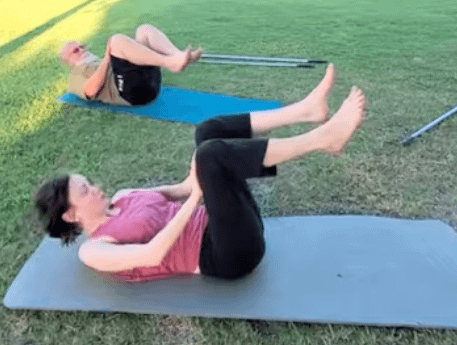
Abs workout for stiff back and Tensor Fasciae Latae pain
the primary focus for TFL or tensor fasciae latae pain relief should be on the muscular support system—abdominal, gluteal, and hip muscles. Weak abs and glutes cause turn off the anterior and posterior muscle chains, while overloading and tightening TFL.  
 
Functional exercises, such as those we offer at FunFit that engage both core and hip stability (like unilateral wall squats, monster walks, and hip abductor strengthening) are recommended alongside abdominal strengthening. This integrated approach addresses both TFL and core muscle imbalances.

How Does Abs Posterior Pull Cure Tensor Fasciae Latae Pain?

Applied Kinesiology Perspective
According to applied kinesiology and contemporary muscle function principles, strengthening the abdominal muscles can indeed help reduce tightness in the tensor fasciae latae pain. Here’s how this relationship is understood:
 
Pelvic Stability: The abdominal muscles, particularly the transverse abdominis and obliques, are essential for stabilizing the pelvis. A stable pelvis helps prevent the TFL from becoming overworked—when the core is weak, the TFL and other hip flexors often compensate, leading to tightness and pain.
 
Force Coupling and Movement Patterns: Proper activation and strength of the abdominals provide a counterbalance to the anterior pull of the TFL and hip flexors. This dynamic, known as a “force-couple,” allows for optimal posterior pelvic tilt, counteracting excessive anterior tilt that can stress the TFL and surrounding structures.
 
Functional Integration: Applied kinesiology posits that muscle imbalance and weak links in the kinetic chain (e.g., weak or poorly firing abdominals) can result in overactivation or compensation by the TFL and related hip structures, which may manifest as pain or tightness.
 
How Strengthening the Abdominals Helps
Reduces TFL Overcompensation: When core stability is lacking, the TFL may become hyperactive to stabilize the pelvis. Strengthening the abdominals helps distribute the workload more efficiently.  This reduces the strain and effectively addresses tensor fasciae latae pain.
 
Improves Pelvic & Lumbar Mechanics: Strong abdominals keep the pelvis and lumbar spine in better alignment, lowering the risk of tightness and discomfort in the TFL.
 
Supports Optimal Movement: With a strong core, hip muscles (including the TFL) can perform their functions in synergy, leading to improved movement patterns and less irritation.

How Do Strong Glutes Cure Tensor Fasciae Latae Pain?

The gluteus maximus and gluteus medius are primary stabilizers and movers of the hip.
 
Weak or inactive glutes force the TFL to work harder during walking, running, and standing, resulting in overuse and pain.
 
When the glutes are strong and properly activated, they share or take over much of the load that would otherwise burden the TFL.
 
How Strengthening Glutes Relieves Tensor Fasciae Latae Pain
Applied kinesiology and clinical research identify these mechanisms:
 
Reduces Overcompensation: Strengthening the glutes ensures that hip abduction, extension, and stabilization tasks are performed by the right muscles, so the TFL is not overloaded or overused.

The best glute strengthening exercises for pelvis stability involve carrying the muscle in and out of contraction with some isometric holds. 

 
Improves Pelvic Stability: Strong gluteal muscles stabilize the pelvis, preventing the pelvis from dropping to one side (which stresses the TFL during single-leg activities).
 
Restores Functional Patterns: Glute strengthening breaks faulty movement patterns, training the body to use correct muscle groups for specific tasks. This leads to improved coordination and decreased TFL strain.
 

Applied Kinesiology Therapy + Functional Fitness Gives Best Results!

Applied kinesiology uses manual muscle testing to locate muscle weakness and recommend specific ab and hip exercises to restore “meridian-muscle” balance to reduce TFL issues. 

Book Your Kinesiology Massage appointment and register for FunFit class today!

Sources:

1. Core Stability Reduces TFL Compensation

Strengthening abdominal muscles (especially the deep core) stabilizes the pelvis and reduces overactivity in the TFL during movement and load-bearing exercises.
 Learn more from Kinesiology of the Hip in the Journal of Orthopaedic & Sports Physical Therapy

2. Functional Exercises Relieve TFL Strain

A kinesiology-based strategy recommends mobilizing tight tissue, activating weak muscles (like glutes and core), and retraining movement patterns to relieve TFL tension.
 Step-by-step guide from Precision Movement on eliminating TFL pain

 3. Core and Hip Muscle Synergy Supports Pelvic Stability

The TFL works with the gluteal muscles and abdominals to maintain pelvic alignment. When core muscles are weak, the TFL may become tight due to compensatory overuse.
Physiopedia overview of the Tensor Fascia Lata’s function and anatomy

 4. Abdominal Activation Boosts Hip Muscle Efficiency

Research shows that activating the abdominal core during hip exercises enhances glute and hip muscle activity, which decreases the burden on the TFL.
Peer-reviewed study on core-hip exercise interaction from NCBI

 5. Applied Kinesiology Perspective on Muscle Imbalances

Applied kinesiology uses muscle testing to identify underactive muscles that contribute to TFL tightness. Strengthening the abs and glutes is often part of therapy.
Explained by Ozark Holistic Center: What Muscle Testing Reveals About the TFL


Leave a Comment

Your email address will not be published. Required fields are marked *

en_USEnglish
Scroll to Top